HR Squads, an organizational design (r)evolution

I have recently read a lot about Squads and how this methodology has helped several companies to gain agility and improve cross-functional cooperation. None of the examples mentioned the HR department. I’d like to propose a new org design model for HR to improve the connection with the business by envisioning HR organized in Squads. I’m not sure if this model already exists somewhere but I wasn’t able to find any information.

For those who are not familiar with this term, Squad is a small cross-functional, self-organized team, usually with less than eight members, that has enough autonomy and knowledge among its members to deliver a specific product. The team members have end-to-end responsibilities, and they work together towards their long-term mission. On Squads the key driver is autonomy. Autonomy to decide what to build, how to build it and how to work together while building it. However, the Squad needs to remain aligned with the company and product mission, strategy and goals.

Autonomy provides employees with a sense of collective ownership; it motivates people to build better stuff and faster, by allowing decisions to be made locally instead of by managers and/or committees. In order to achieve this autonomy, it must be a multidisciplinary team, with different skills and capabilities represented.  A simple Squad, for example, can be composed of a Product Owner, responsible for understanding user demands, a UX Design, responsible for the user experience and the product interface, and five or six developers, who will turn the user’s needs into reality. They may functionally report to different managers but the main focus is on community rather than hierarchical structures. This methodology has been introduced years ago by Spotify and today, several technology companies, whether large or startups, still use this concept to manage their technical teams.

Why am I thinking that this model could work in HR?

During the last few years, HR realized the need and urgency to reinvent itself to get closer to the business and play a key role in the organization. One of its attempts was the creation of the Business Partner model by D.Ulrich. Many years later, the figure of the Business Partner is still a mystery to several companies that often failed in their attempt to implement it.

By bringing HR closer to business, the intention was to strengthen the relationship between the two in order to translate business and people needs in good HR product and experiences. The reality was that this move often strengthened its operational support role, without effectively contributing to the organization’s strategy. HRBPs were/are often seen as the go-to people for any people related matters and the implementers of processes and projects coming from the CoEs (centers of expertise). We can attribute this failure to different reasons but one thing is sure: pretending that a single person can effectively master such different topics as recruitment, compensation & benefits, performance management, business strategy, people engagement, coaching, analytics, legal and compliance, project management, internal communication and much more, and call this profession HR Business Partner, is very ambitious.

On the other hand, companies that do not have this role often complain about the amount of time they need to spend to find answers to even simple HR questions due to the fact that their different HR functions are not always aligned or responsive. It is common, for example, that Recruitment strategies are not linked to Performance Management strategies, which may not be linked to rewarding strategies etc. In addition to the waste of time, this lack of alignment results in the implementation of projects that are hardly being able to create the desired impact on the employee experience and create confusion for leaders as they need to have several different points of contact within HR to share their feedback and thoughts. This is one of the reasons why I do think that implementing a Squad structure in HR can help creating the desired alignment between the different HR functions and the business.

My idea of Squad in HR would be to split the HRBP role with a small group of people. Instead of having a HR Business Partner that serves the area of Technology, for example, you will have a team of 6 HR professionals who are experts in their fields (like recruitment, learning & org development, comp&ben, employee relations, people analytics, internal communication) that work together in projects that involve all these aspects of the employee experience. This squad can then behave as part of an established tribe within the business area. Thus, this team can fully understand the needs of this specific tribe or business area and can create products, standards, practices and projects that help them achieving their goals and objectives. Representative of the business should be regularly involved in the different phases of each projects and actively contribute to the successful implementation in their respective areas.

It is common that, in a traditional HR structure, the different HR functions are located far not only from the business but from the different HR functions too. In this proposal, the squad needs to be physically close to ensure the rapid exchange of information. For a squad to be successful it is necessary to reduce hierarchy and increase trust in the employees. Only in this way is it possible to build autonomy in the team. The decentralization and/or reduction of organizational lawyers can be perceived as a challenge in many companies where it is still common to see areas of “support” such as HR, Finance and Legal often operating in a hierarchical culture.

In a Squad, the role of the leader is to point out the objective and the problems to be solved, and let the team find the solution in the way that makes more sense to them. In this methodology, you have a matrix management structure, where members report to the “technical” leader of their specialty while dotted line reporting to the leader of Squad. For example, the recruiter will report both to a Recruitment Manager, for “craft” matters, and to the Squad Lead (ex-HRBP), who will be responsible for directing the projects to be delivered to internal customers and ensure alignment within the squad.

In my opinion, this type of structure reduces the chance of HR to create projects disconnected from the needs of their internal customers or create programs that hardly connect to the companies’ objectives. After all, how many of us in HR have not received feedback that we are “too procedural, un-flexible and far from being close to the people needs” or that we are “imposing meaningless projects and programs” to them? It is also common for HR to receive criticism related to the speed of its deliveries. Many leaders point out that their needs are not met within the expected time, and when they are not always meet all the necessary requirements.This is common because, in HR, we are used to the cascade model of project management, a sequential model in which the process is seen as a constant flow forward (like a cascade) through the different phases. In this model, for a new stage of the project to start the other must have been finalized.

These criticisms play a role in the disengagement of HR professionals too. When you delay delivering a project, it means that you put a lot of effort and time into this project, and if it is criticized or no longer makes sense for the company, you may feel demotivated and reluctant to start a new project. From the Squad model will become easier for HR to start using Design Thinking and User Experience tools to validate projects hypotheses and A/B testing, pilot projects, MVPs to test the project in a controlled reality and thus understand their possible problems and correct them way before gaining scalability.

Certainly, the process of implementing Squad in a support area is a big challenge. More than just a new process or org structure introduction, it is a mindset and cultural change in which several factors play a key role, such as having the right people on-board, leadership& company buy-in and sponsorship, investing in people new skills development. However, I strongly believe that the autonomy of a Squad will bring immediate benefits to the company. With a deeper and more integrated business approach, speed in the implementation of projects that cover the full spectrum of the employee experience, reduction of errors and increase in clients usability and satisfaction, I can only anticipate a greater potential for business impact. Last but not least, the deserved recognition of HR as a strategic area for the organization.

THE ROLE OF HR IN CHANGE MANAGEMENT

I was recently reading an article from Pia- Maria Thoren on the Role of HR in the organizational shift towards Agile.  According to this, and to many others based on the VUCA`s theory that I must have certainly mentioned in this blog, organizations who don’t manage to make the shift towards Agile will slowly get weaker and soon out of the game and only the ones that will manage to transform and adapt to the needs of todays and tomorrows participation economy, will survive and flourish.

What I found really interesting about this article is the emphasis on the role of the HR department in this vital transformation.

She describes how for small and medium sized companies managing the shift is easier because they have less top-down structures but for bigger and more complex companies – with systems, processes and structures- this shift become less obvious.

What often happens is that one department tries to change but the problem remains in other departments and since all parts are depending on each other, the brave department that initiated the change will either be forced to give up (and return to the old structure) either will be able to influence/persuade another department to start adopting the same structure. In the best case scenario, the change will happen, but in a looong period of time.

However there is one functional department in most organizations that can affect ALL of the others at the same time: The Human Resources or People department. How could we have underestimated the power of HR till now?? 😉

HR has been struggling lately with criticism of being some kind of organizational police that stop organizational performance and engagement by implementing the very processes that were supposed to increase the same.  We should step up and take responsibility for this change, in a way where we show what we can really do for the organization.

Especially when centrally organized, HR control program and projects that are cross-departmental like:

  • Leadership programs
  • Change management
  • Organizational development
  • Employee engagement and retention
  • People development & learning
  • Reward strategy and bonus systems
  • Talent acquisition
  • Long term workforce management
  • Internal communication

All the above areas cut through the whole organization and are the levers that can support or stop the change to a more agile future. By developing them in a way that will enhance performance and engagement and by providing different structures and focus on customer value instead of rules, HR can lead the company through the change in a way that no other department is capable of.

It’s the system that needs to be managed, not the people. We don’t need to do more things, or implement more processes, difficult frameworks, methods or models – we just need to learn how to stop hindering people from giving their best effort to the company by providing the wrong structures.

We have the power to decide on these structures that can support people to perform or make it more difficult to contribute in creative and innovative manners.

The role of the HR Business Partner become then critical when it comes to communicate and influence the buy-in of the relevant stakeholders and to adapt the new structure to the local context – especially if the company is a multinational with presence all over the world.

Change management will be an essential asset to have for a good HRBP. Understanding, adapting and somehow leading this transformation will be critical for the success of the company. It’s a path of trial and error and to find the best way for each company. Not easy but necessary. The agile principles and mindset can help and the tools and guidelines may work, but not always. Best practice is already old practice, continuous learning from trial and error will be the only competitive advantage in the future.

It’s all about the people, the relationships and the system in which the people live and work. If we can give the right prerequisites to people, they will take care of the rest.


ORGANIZATIONAL ASPECTS OF THE PARETO PRINCIPLE

The Pareto principle (also known as the 80/20 rule) specifies an unequal relationship between inputs and outputs by stating that, for many phenomena, 20% of invested input is responsible for 80% of the results obtained.

This principle is named after the Italian economist Vilfredo Pareto who, in 1896, published his first paper “Cours d’économie politique” where he essentially showed the unequal distribution of wealth among the population in Italy: approximately 80% of the land was owned only by 20% of its inhabitants.

Although the original observation was in connection with population and wealth, generally speaking the Pareto Principle is the observation that most things in life are not distributed evenly. It can mean all of the following things:

  • 20% of the input creates 80% of the result
  • 20% of the workers produce 80% of the result
  • 20% of the customers create 80% of the revenue
  • 20% of the bugs cause 80% of the crashes
  • 20% of clothes in a wardrobe are worn 80% of the time
  • And on and on…

However there is a common misconception that the numbers 20 and 80 must add to 100. They actually don’t!  20% of the workers could create 10% of the result. Or 50%. Or 80%. Or even 100%.

Clearly most things in life (effort, reward, output) are not distributed evenly and definitely some contribute more than others.

Out of 100 experiments/projects/candidates perhaps only 1 will be “cool”. That cool idea/product/person will result in majority of the impact (the green line of the graph below). We’d like life to be like the red line, where every piece contributes equally, but that doesn’t always happen:

best_80-20


Why is this useful to know from a HR and Managerial perspective?

In a perfect world, every employee would contribute the same amount, every bug would be equally important, every feature would be equally loved by users and planning would be easy but unfortunately this is not the case. The rule helps us realizing that the majority of results come from a minority of inputs. Knowing this, if:

20% of workers contribute 80% of results- We must focus on rewarding and retaining these employees.

20% of customers contribute 80% of revenue- We must focus on satisfying these customers and keep strong relationship with them

20% of bugs contribute 80% of crashes: Focus on fixing these bugs first.

The examples go on. The point is to realize that you can often focus your effort on the 20% that makes a difference, instead of the 80% that doesn’t add much.

This is surely one of the simplest and most powerful management tools on the planet and its potential use can cover most aspects of work, business, organizational development and personal life.

In economics terms, there is diminishing marginal benefit. This is related to the law of diminishing returns: we more often are spending lots of time on the minor details.

The value of the Pareto Principle for managers and leaders is that it reminds them where to really focus on. Of the things you do and work during your day, only 20 percent really matter. Those 20 percent produce 80 percent of your results. Identify and focus on those things. If something in the schedule has to slip or if something isn’t going to get done, make sure it’s not part of that 20 percent.

Same theory applies to people management: managers should focus their limited time on managing only the superstars. In reality managers spend a large portion of their time on employees that demonstrate performance or behavior issues.

All of us, HR and Management, should spend more time on acknowledging the major contributions of the excellently performing “vital few.” Recognition programs, rewards, access to additional diverse responsibilities can motivate this positive vital few to perform even better and to encourage other team members to improve their own work habits.

What can occur is similar to the spreading of a “positive performance” antibody in the work place. The vital few can become the “vital many” with that kind of encouragement.

There is another use perhaps for the “vital few” idea, one which probably even Pareto did not consider. That is the role of an employee’s family/friends/hobbies in the employees’ personal life. More and more the desire and request of a work-life balance reflect the need of spending more time than we now do nurturing our relationships with our family and friends, cultivating our hobbies and spend time more wisely.

For the employer, this also means ensuring that the benefit program is flexible and responsive to life stage changes that affect all of us. Our benefit needs are different when we have young children than when we don’t, or when we are single or approaching retirement.


AGILE MODEL APPLIED TO HR

Hello Agile people!

Today I’d like to share with you an article written by Tom O’Shea in his blog Agility- consultancy and training where he explains a new model of Agility by describing five characteristics needed for organizations to be capable of anticipating and responding to changing demands and adapting to new requirements. Furthermore we will see how this model could be nicely adapt and adopt by an HR Department.

Five Drivers of the Agile Model

Agility in individual leaders, teams or organizations is driven by five critical capabilities: Anticipating Change, Generating Confidence, Initiating Action, Liberating Thinking, and Evaluating Results. Each of these drivers must exist within three enterprise domains (people, processes, and technology) in order to create and sustain an agile enterprise.

Anticipate Change: Interpret the potential impact of business turbulence and trends along with the implications to the enterprise.

  • Requires effective processes for: Visioning, Sensing and Monitoring

Generate Confidence: Create a culture of confidence and engagement with all stakeholders especially associates in effective and collaborative teams.

  • Requires effective processes for: Connecting, Aligning and Engaging

Initiate Action: Provide the fuel and the systems to enable things to happen proactively and responsively, at all levels of the organization.

  • Requires effective processes for: Bias for Action, Decision-Making Capability, Collaborating

Liberate Thinking: Create the climate and conditions for fresh innovative solutions by empowering, encouraging, teaching and expecting others to be innovative.

  • Requires effective processes for: Bias for Innovation, Focusing on Customers and Idea Diversity

Evaluate Results: Maintaining a strong focus and feedback system to continuously learn and improve from actions and changing dynamics.

  • Requires processes for: Creating Expectations, Real Time Feedback, Fact Based Measures


Key question for the day based on the above model:

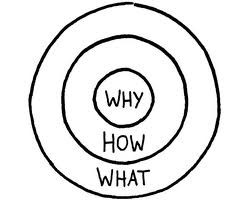
How can senior HR leaders inspire their teams to see their roles as Agility Champions and begin building their own strategic roadmap for creating the AGILE HR function? Naturally, it all begins with engaging our teams to discover some CLARITY on core fundamentals: START WITH WHY.

WHY

Just as with inspiring leaders, inspiring teams benefit from the occasional re-grounding around the three simple questions:  “Why are we here, How will we be successful and What does that success look like to our stakeholders”? This can be very powerful when done in a climate of real hopefulness and possibility where the conversation is actually connected to the company success model.

Teams of all kinds get inspired and energized when they see and feel alignment to a success model and leadership climate building learned hopefulness and not the kind of learned helplessness profiled for HR years ago – but still prevalent in too many corporate environments. We see this learned helplessness also infecting many HR teams where the corporate rhetoric of people-centric culture does not match up with every day corporate practices. Goes almost without saying that this climate is incongruent with creating real Agility Champions.

Just imagine the HR team as fully engaged Agility Champions – focused, fast and flexible. That vision can and, frankly, needs to be a new reality if the HR function and team are to be full business partners contributing to the transformation needed in organizations facing the VUCA (volatile, uncertain, complex and ambiguous) world.

Let’s outline some of the capabilities that operate in AGILE HR TEAMS using the Agile Model framework:


Anticipate Change ·         They have established good HR team clarity in VISIONING the why, how and what success looks like for the team at all levels throughout the HR organization.

·         They have identified the internal and external HR stakeholder community and mapped the forces of change that helps them become proactive in SENSING change early.

·         They systematically MONITOR key internal and external factors to recognize patterns and trends on critical factors potentially impacting organization and HR team success.

Generate Confidence ·         They continuously reinforce line of sight within HR team and stakeholders to energize and CONNECT all team members into a positive community of practice and expertise.

·         They insure close ALIGNMENT with vision, values, priorities, behaviors and resources actively percolating across the team to build highly credible HR team brand value.

·         They expect, create, support and value highly ENGAGED levels of individual and team ownership and involvement with all levels throughout the HR team

Initiate  Action ·         They expect and promote a positive BIAS FOR ACTION and sense of urgency for doing right things throughout the HR team as well as catalysts for positive change beyond.

·         They have built HR team skill, accountability and trust through better and faster DECISION-MAKING encouraged and expected at all levels within the team.

·         They are champions of COLLABORATION and skillful in building cooperation and commitment in everything they do within the team as well as with stakeholders.

Liberate Thinking ·         They have built a climate with a BIAS FOR INNOVATION valuing and always promoting fresh innovative solutions to match the growing complexity in business issues.

·         They are driven by a CUSTOMER FOCUS orientation that recognizes superior customer experience naturally starts internally and must be modeled at all HR touch points.

·         They actively understand the power of IDEA DIVERSITY and find ways to reach out and incorporate involvement and ideas from stakeholders at all levels.

Evaluate  Results ·         They have CREATED EXPECTATIONS aligned with the enterprise success model, tied them to satisfying stakeholder requirements and with goals linked across the HR team.

·         They have an active and progressive conversation flow providing REAL TIME FEEDBACK on things that matter with all stakeholders and HR team members.

·         They have established and pay attention to FACT BASED MEASURES in their HR Team Success Dashboard which helps them triage team vital signs, monitor key agility indicators in order to recognize improvement priorities and critical success factors


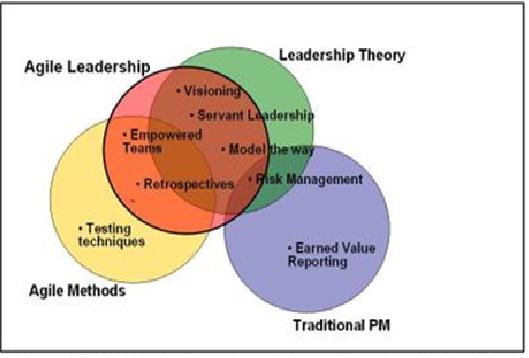
Management v/s Agile Leadership

Management and Agile leadership are usually projected as synonym terms, however they differs hugely from each other. Managers focuses more on making the team work where agile leader needs to embrace the agile principles of being flexible and adaptable along with motivating others to follow them. Main differences:

Management Agile Leadership
Management focuses on tasks Leadership is about people
Management focuses on control Leadership is about empowering and letting people control
Management focuses on efficiency Leadership is about effectiveness
Management focuses on doing things right Leadership is about doing the right things
Management focuses on speed Leadership is about direction
Management focuses on practices Leadership is about principles

Looking at this, agile leadership varies from management because leadership comes by right and not by appointment. The right to lead has to be earned by the agile leader by gaining respect from the team.

Agile Leadership means:

  • Being a model: An agile leader should been seen as a model of desired behavior and should demonstrate the four characteristics of a leader: Honesty, Forward looking/thinking, Competent and Inspiring.
  • Creating and communicating a vision: An agile leader should be able to set forth a compelling vision for the team. The communication should be in an inspiring manner that will channelize everyone’s energy.
  • Enable others to act: Agile leadership involves trusting the team to do the work and also enabling them so that they are able to perform the work.

On top of that, an agile leader needs to pursue certain leadership practices in order to enable smooth work process and successful project development.

Best Practices of Agile Leadership:

  • Willingness to change/challenge the status quo: An agile leader should be willing to take the bull by its horns in order to enforce a change. He or she should be capable of handling risks, learning from mistakes and generating small victories.
  • Getting the right people involved: The most important requirement for successful development of projects and daily work is having an efficient (agile) team. An agile leader should find a way to get the right team in place.
  • Encouraging the team members: Besides leading, an agile leader should also know how to show appreciation, reward and recognition to the agile team those who work with him or her in the project.


Agile-Leadership-and-Management


How to Use Scrum Values in Difficult Discussions

I found this very interesting concept in an article that I like to share. I hope you find it useful too!

The scrum values are:

scrum values

During difficult discussion, you will need them all, no matter which role you’re playing in this discussion. Begin anywhere, it doesn’t matter which you start with.

When you have to say something painful, invoke Respect: “I respect what you’ve done. (Describe exactly what you respect.) “I’m asking you to respect what others experienced.” (Describe the problem.)

When you have to hear something painful, invoke Focus: “I don’t like what you’re saying, but let me focus to be sure that what I heard is what you meant. (Repeat what was said.)

It’s a good idea to thank each other at this point: gratitude finds good in any situation, and it’s calming.

When you’ve gotten through Focus, and you both agree what was said, then you both invoke Openness together. The hearer acknowledges that there were unintended consequences of what he thought was a good thing, and these consequences hurt team performance. The speaker acknowledges how hard it is to become aware.

This is also a good place to thank your partner in this discussion for their openness and their courage, because this part of the conversation includes the truths that are so hard to say.

If at this point you can get back to the Venn diagram that invokes Commitment. No matter which way it goes, the walk into the future goes better when it’s maintained with a decent regard for the dignity of every human being. That means getting out of denial.


The Agile HR Manifesto

I could not believe to my eyes when I read an article recently published in the blog sympa.net : somebody put together and published the very first Agile HR Manifesto! Hurrah!

I would have loved to participate in its redaction but I was not aware that someone out there was also talking and discussing about this very same subject. Unfortunately! But better later than never… I sent them a message, let’s hope they will come back with good intentions! Will keep you posted…

In the meantime, find below the core principles and philosophy shared in the Manifesto.

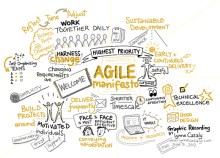
The Agile Manifesto for HR contains 12 principles that we should bear in mind when we work in an agile way in HR:

  • Our highest priority is to satisfy customers by early, continuous provision of high-value HR deliverables (customers = managers, employees and external customers)
  • Welcome changing requirements, including late in the development process or project
  • Deliver (HR programmes, tools, services) frequently, the more often the better
  • In HR projects, HR should work with operational managers, other departments and employees (cross-departmental teams) on a daily basis throughout the project
  • Build projects around motivated individuals. Give them the environment and the support they need and trust them to do their job
  • Face-to-face communication is the best and most efficient way to exchange information. Both to and within the HR team
  • Working HR programmes, tools and services are the primary measure of development
  • Agile methods focus on endurance and develop at a constant, steady rate
  • Continuous attention to high quality and good design increases the ability to adapt.
  • Simplicity – the art of maximising the amount of work that is not done – is important
  • The best architecture in HR deliverables arises out of the self-organising team
  • At regular intervals, the team reflects on how it can be more effective and adapts its behaviour accordingly

I kind of share pretty much the same vision- very spot on- BUT for the principles nr 8 and 9 where I would change it with:

  • Agile methods focus on continuous improvement through small steps and constant experiments- fail fast, fail often!
  • Continuous attention to the constant changes in the business and local environment/ ees engagement increases the ability for HR to adapt and to really add value

Wishful thinking: How cool would it be to see Hackathons running in HR departments? What innovations would come out of them that will have a positive impact for the people and the organizations??

How to improve communication in your Team using the Agile Methodology

Definition of Agile retrospective:

An Agile retrospective is a meeting that’s held at the end of an iteration in Agile software development. During the retrospective, the team reflects on what happened in the iteration and identifies actions for improvement going forward.

Each member of the team members answers the following questions:

  • What worked well for us?
  • What did not work well for us?
  • What actions can we take to improve our process going forward?

The Agile retrospective can be thought of as a “lessons learned” meeting. The team reflects on how everything went and then decides what changes they want to make in the next iteration. The retrospective is team-driven, and team members should decide together how the meetings will be run and how decisions will be made about improvements.

An atmosphere of honesty and trust is needed in order for every member to feel comfortable sharing their thoughts.

In IT this is how it looks like:

retrospective flow

But this model could easily be adapted to any project context, when more people/stakeholders need to work in teams.

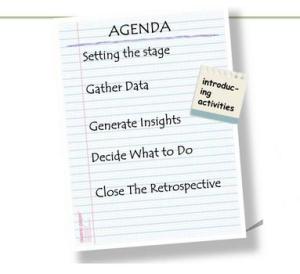
Where to start? By setting the Agenda, of course!


Retro agenda

It’s also crucial to underline that  “Regardless of what we discover, we truly believe that everyone did the best job they could, given what they knew at the time, their skills and abilities, the resources available, and the situation at hand. We are here together to find ways to improve, to discover solutions to problems, not to find scapegoats or lay blame. Whatever we discover will make us stronger as a team.”

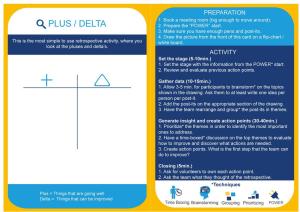
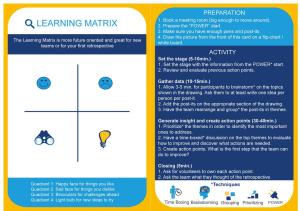
The base of a Retrospective Exercise uses the traditional questions “What went well?” and “What can we improve?” method, but there are several models that you can use to make it different and more fun every time you do it. My favourite, introduced by the IT AgileTeam @ Booking are:

  • The Star Fish

Star Fish

  • The Plus/ Delta:

 Plus-Delta

– The Learning Matrix:

Learning Matrix


To Sum Up: The retrospective is a window for teams to inspect and adapt, to learn about what works and what does not work, and to find better ways of working together, always striving towards continuous improvement.

Giving and receiving feedback is at the heart of any successful agile interaction, process, implementation etc. and when doing this correctly you are certainly contributing/ leading your team towards a model of High Performing Team.


Agile approaches to HR management

So what does all of this have to do with human resources?

For one thing the four values of agile development can be easily applied to the practice of HR. Incorporating adaptability, transparency, simplicity and unity can help improve HR service delivery.

Adaptability is important in the face of changing business needs, while simplicity is important when designing HR programs and practices that don’t cause confusion, alienate managers and employees or try to accomplish too much. Unity applies with respect to HR working together and ensuring it isn’t working in silos or at cross purposes with the business. Transparency is important in gaining the trust of managers and employees and explaining why things have to be done in a certain manner.

I have a good example to share about what we are currently doing at Booking: HR and Business working together to create the best possible Employee Journey experience in IT. This means challenge the current status of our HR core policies, be open to feedback and change, truly listen and understanding the business needs and work together to make sure the communication and implementation phase will be successful. To achieve that we really need to team up with the Business and make sure everyone understands the push and the limit of each proposal and new change.

An agile model of this specific example is the willingness to incorporate feedback into the new project so that changes can be made incrementally and early in the process. From an HR perspective, it’s important to work closely with other stakeholders and obtain their input very early on. For ex. as part of the Employee Journey, we are now changing the set up of the new HRS toll only implemented at the beginning of last year. Why? This was done by thinking Global, in big steps and without thoroughly consulting the immediate stakeholders. This handed up in lots of frustration from the management side with a feeling that HR was pushing process to them or that the processes were too long, with too many approval steps for example. Although the intention of the HR department was clearly positive (empower managers, give them the right tool to find all the info needed about their teams, create reports from whenever and wherever, initiate processes that wouldn’t need email-chains approval etc.) something clearly went wrong. But What/Why?

“Giving and receiving feedback is at the heart of any successful agile implementation”

Looking back, this was an clear project where an effective Retrospective would have made a huge difference.