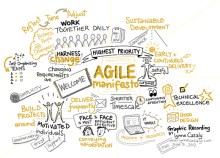
AGILE is a development methodology, popular among web developers. Agile is based on the idea of iterative, incremental development. Every large software project is broken down into small, achievable components. The components are ranked in importance (usually features are categorized as “must-have” or “nice to have”) and are grouped into time periods called sprints. During a sprint, each team member works intensely on a part of the project and completes something that works. The team reconvenes at the end of the sprint to compare notes, see what has been accomplished and adjust the list of remaining tasks.
The term scrum is derived from rugby, where a scrum restarts the game after the ball has gone out of play. A software scrum gets the team back together and gets everyone moving in the appropriate direction.
Even though it is a methodology that governs high-tech projects and contexts, the idea of the scrum and agile could definitely be applied to a tons of HR projects because everything which makes Agile work for software also works for management, leadership, organizational design.
I do think that the concept of Agile HR represents a new way to partner with the Business and to re-define its mission.
What I do always hear from the Business:
“HR doesn’t understand us, they don’t get it.” “HR Processes are too slow or they don’t reflect business changes fast enough”. “Performance cycles dont give people fast-enough feedback and learning”. “Rewarding program are not clear as well as career advancement”
To work in an Agile HR environment will basically mean rethinking the traditional HR role in the company: it is not just to implement policies and procedures, controls and standards, drive execution but rather to facilitate and improve organizational agility. Driving agility means driving programs that create adaptability, innovation, collaboration, and speed.
Examples of Agile HR strategies:
- Designing the organization into (small) high-performance teams that set their own targets
- Delivering a strong, focused mission and values to keep everyone aligned
- Creating systems with lots of transparent information
- Building a focus on continuous learning and learning culture at all levels
- Implementing a strong external employment brand that attracts “the right type” of people
- Hiring and promoting experts, not general managers
- Encouraging and teaching people to give each other direct feedback
- Creating programs for peer-to-peer rewards and recognition
- Developing programs to foster diversity in teams
- Training leaders at all levels of the company to act as hands-on coaches, not “managers”
This basic but revolutionary concept simply changes the HR focus and mission and really facilitate the interaction between HR and the Business. Guaranteed!
 agile hrbp