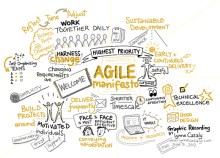
The world has become more “instant” every day. Companies which can adapt to agile management models will most probably move faster and out-perform their competitors. Thinking about how implementing an agile model of management and HR would be key for reaching that goal.
Before listing some of the key HR processes that could benefit from this approach, let’s make clear some of the IT terminology that will be used.
Waterfall Approach: a way of building software which involves a step-by-step process of requirements definition, refinement, and software engineering in which progress is seen as flowing steadily downwards (like a waterfall) through the phases of conception, initiation,analysis, design, construction, testing, production, implementation and maintenance. It can take years. This concept was developed in the 70ies.
Sprint: In product development, a sprint is a set period of time during which specific work has to be completed and made ready for review. Today software companies develop systems in weekly “sprints“ and meet every day in a 15 minute “scrum” to make sure that everyone knows what to do and they have the information they need to get things done. This is part of the Agile approach/methodology.
Agile is also built on the understanding that people learn in small chunks – so while it may in fact take a year or two to build a highly complex website, no person needs to try to understand the entire engineering program in advance. The daily work becomes a part of a bigger project in a continuous, dynamic process.
Where can we see these 2 different approaches in the HR traditional processes?
- Annual performance appraisalsuse an older “waterfall” method – continuous feedback and recognition is an “agile” approach.
- Top downcascading goals are a “waterfall” approach – rapidly updated “objectives and key results” (sometimes called OKR – widely used at Google) is an “agile” model, but I would actually challenge this as well.
- Traditional annual compensation process is a “waterfall” model – continuous recognition and social recognition systems should be put in place (agile).
- Traditional formal training as a tool of development is a “waterfall” model – rapid e-learning and informal learning is an “agile” approach.
- The annual development planning processis a “waterfall” model – an ongoing coaching relationship is an “agile” model for leadership.
- The annual employee engagement surveyis a “waterfall” model – Pulse surveys, online idea factories or open blogs are an “agile” model for employee engagement.
Let’s look into these processes more in details.
I’d like to start reviewing the Performance Management process.
This is probably THE most criticized HR (traditional) process: the annual/ semi-annual/quarterly appraisal or so called employee performance management process.
We all agree that there are many ways to improve the way people are managed but performance management (which is typically viewed as something which HR is accountable for) needs to evolve.
Brief explanation of the traditional process : Managers- and sometimes employees- set goals (annually or quarterly) using some cascading process, track these goals periodically, and at the end of the year the managers collects feedback and “deliver” the performance review. The result: in most companies the process is uncomfortable, riddled with frustration, and often out of date.
Consider the below problems and scenario:
- Goals change continuously during the year.While corporate objectives may not change, business conditions change constantly so employees and their managers must continuously adjust their priorities.
- KPIs for specific roles: is it really possible to set them? Ex. for a developer or a designer or a Product Owner or a creative/art director?
- Feedback should take place continuously. Employees are getting feedback every minute of the day (hopefully). They are doing great things and they are making mistakes. When they make a mistake, they should get feedback immediately and the organization should immediately adapt. Why should all this be “saved up” for the end of the year?
- Performance feedback comes from all directions. Today most workers work in teams with highly (geographically & cross-functional) distributed teammates – and we are likely to get performance feedback from every possible direction (including from customers and partners). This “continuous feedback” loop takes place without the manager involved. Just like in Agile development, we need a process for continuous improvement to take place with or without the manager.
- We cannot predict the future.Yes, it is important to set goals and establish long range objectives. But the world changes. Shouldn’t our performance management process be flexible enough to adapt immediately when business conditions change?
- Old information is lost information.When feedback and performance information is available, it should be acted on immediately. As it gets older it becomes less useful, and eventually becomes irrelevant. Why would we institutionalize a process which takes an entire year before employee feedback is delivered?
I understand that this way of looking at it may sound a little unconventional and this may have a profound impact on leadership, management, and human resources but I think it is worth starting a discussion around it.
 agile hrbp