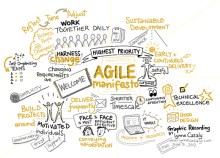
Definition of Agile retrospective:
An Agile retrospective is a meeting that’s held at the end of an iteration in Agile software development. During the retrospective, the team reflects on what happened in the iteration and identifies actions for improvement going forward.
Each member of the team members answers the following questions:
- What worked well for us?
- What did not work well for us?
- What actions can we take to improve our process going forward?
The Agile retrospective can be thought of as a “lessons learned” meeting. The team reflects on how everything went and then decides what changes they want to make in the next iteration. The retrospective is team-driven, and team members should decide together how the meetings will be run and how decisions will be made about improvements.
An atmosphere of honesty and trust is needed in order for every member to feel comfortable sharing their thoughts.
In IT this is how it looks like:

But this model could easily be adapted to any project context, when more people/stakeholders need to work in teams.
Where to start? By setting the Agenda, of course!
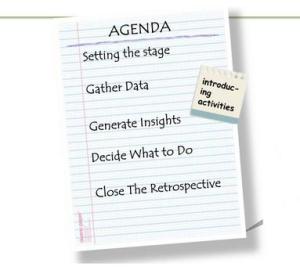
It’s also crucial to underline that “Regardless of what we discover, we truly believe that everyone did the best job they could, given what they knew at the time, their skills and abilities, the resources available, and the situation at hand. We are here together to find ways to improve, to discover solutions to problems, not to find scapegoats or lay blame. Whatever we discover will make us stronger as a team.”
The base of a Retrospective Exercise uses the traditional questions “What went well?” and “What can we improve?” method, but there are several models that you can use to make it different and more fun every time you do it. My favourite, introduced by the IT AgileTeam @ Booking are:
- The Star Fish

- The Plus/ Delta:

– The Learning Matrix:

To Sum Up: The retrospective is a window for teams to inspect and adapt, to learn about what works and what does not work, and to find better ways of working together, always striving towards continuous improvement.
Giving and receiving feedback is at the heart of any successful agile interaction, process, implementation etc. and when doing this correctly you are certainly contributing/ leading your team towards a model of High Performing Team.
 agile hrbp