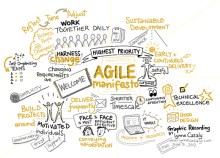
I was recently reading an article from Pia- Maria Thoren on the Role of HR in the organizational shift towards Agile. According to this, and to many others based on the VUCA`s theory that I must have certainly mentioned in this blog, organizations who don’t manage to make the shift towards Agile will slowly get weaker and soon out of the game and only the ones that will manage to transform and adapt to the needs of todays and tomorrows participation economy, will survive and flourish.
What I found really interesting about this article is the emphasis on the role of the HR department in this vital transformation.
She describes how for small and medium sized companies managing the shift is easier because they have less top-down structures but for bigger and more complex companies – with systems, processes and structures- this shift become less obvious.
What often happens is that one department tries to change but the problem remains in other departments and since all parts are depending on each other, the brave department that initiated the change will either be forced to give up (and return to the old structure) either will be able to influence/persuade another department to start adopting the same structure. In the best case scenario, the change will happen, but in a looong period of time.
However there is one functional department in most organizations that can affect ALL of the others at the same time: The Human Resources or People department. How could we have underestimated the power of HR till now?? 😉
HR has been struggling lately with criticism of being some kind of organizational police that stop organizational performance and engagement by implementing the very processes that were supposed to increase the same. We should step up and take responsibility for this change, in a way where we show what we can really do for the organization.
Especially when centrally organized, HR control program and projects that are cross-departmental like:
- Leadership programs
- Change management
- Organizational development
- Employee engagement and retention
- People development & learning
- Reward strategy and bonus systems
- Talent acquisition
- Long term workforce management
- Internal communication
All the above areas cut through the whole organization and are the levers that can support or stop the change to a more agile future. By developing them in a way that will enhance performance and engagement and by providing different structures and focus on customer value instead of rules, HR can lead the company through the change in a way that no other department is capable of.
It’s the system that needs to be managed, not the people. We don’t need to do more things, or implement more processes, difficult frameworks, methods or models – we just need to learn how to stop hindering people from giving their best effort to the company by providing the wrong structures.
We have the power to decide on these structures that can support people to perform or make it more difficult to contribute in creative and innovative manners.
The role of the HR Business Partner become then critical when it comes to communicate and influence the buy-in of the relevant stakeholders and to adapt the new structure to the local context – especially if the company is a multinational with presence all over the world.
Change management will be an essential asset to have for a good HRBP. Understanding, adapting and somehow leading this transformation will be critical for the success of the company. It’s a path of trial and error and to find the best way for each company. Not easy but necessary. The agile principles and mindset can help and the tools and guidelines may work, but not always. Best practice is already old practice, continuous learning from trial and error will be the only competitive advantage in the future.
It’s all about the people, the relationships and the system in which the people live and work. If we can give the right prerequisites to people, they will take care of the rest.
 agile hrbp